IBCA session on building a service for deceased infected claims
Purpose
Between 28 and 31 October 2025, IBCA met with community members who are representing someone who had received infected blood or blood products and has since died. These community driven development (CDD) discussions focused on how IBCA can design the compensation service for deceased infected people’s claims in a way that is clear, compassionate and consistent with the Inquiry’s recommendations.
The purpose of these sessions was to understand what matters most to individuals, both emotionally and practically, when making a claim on behalf of someone who has died, and how IBCA can make the process as simple, trauma informed, and fair as possible.
Format
Each session lasted around 90 minutes and was held virtually. Every discussion began with an acknowledgement of how distressing these subjects can be. Participants were reminded they could take a break or leave at any time. The summary notes were shared with all attendees for review and comment before publication. The insights gathered will shape the design of the deceased infected claim journey and how IBCA communicates with families as this group of claims opens.
You can see the slides that were shared in advance of the sessions here.
Topic 1: Approach to claims while we wait for further documentation
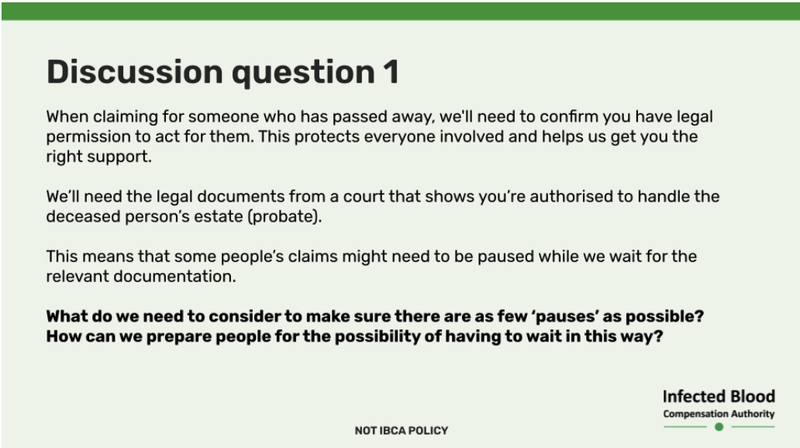
Participants told us that the practical process of gathering legal documents such as probate, confirmation or letters of administration must be handled with care, clarity and compassion. They stressed that every additional step reopens loss and that communication needs to focus on help and readiness, not on penalties or delay.
A shared, urgent request was to eliminate unnecessary administrative repetition and delays. People who will claim questioned the need to resubmit documents when applying for full compensation, especially since they have “sent in all of this information for the first interim payment,” and asked, “If you’ve already proven it to one body, why can’t you transfer it across?”
Many parents and relatives said that the current systems can be intimidating or confusing, especially for older people. One parent explained, “We have to bear in mind that a lot of parents are elderly and unwell. Many are not technically minded and have problems with computers. They clearly need a lot of support to do this”. Another added, “In the IBCA newsletter, it’s all links. You could send a hard copy. A lot of us just want something we can hold in our hands”. We confirmed that hard copies are available on request.
Across all five sessions, there was strong agreement that IBCA should give clear, early guidance on what documents will be needed, and practical advice on how to get them. Several participants proposed simple checklists or printed step-by-step guides. One person said, “The sooner you start, the sooner you finish. IBCA should have told people a long time ago what they’ll need in order to make a claim”. A major theme raised in every group was that IBCA should, wherever possible, use probate and identification documents already supplied to the Infected Blood Support Schemes for the first and second interim payments, rather than asking for them again.
Many said this would prevent unnecessary distress and delay. “You have the information from [support schemes], so you have a head start here, get that from the schemes and people don’t need to ask for it again”, one participant said. Another added, “What is frustrating is that we have already got all of that documentation and passed it to other government departments. It seems sensible to get that transferred to you.” Others echoed this repeatedly: “If you’ve already sent that documentation to the schemes, you should be able to make it less painful. As a parent who has lost a child, every pause and every step makes it more painful”.
Many parents reflected on the emotional impact of administrative requests. “We don’t want sleepless nights, thinking, oh I’ve got to sort that out in the morning,” one said. Another added, “Every day we are living the same pain. It never leaves us. This is doubling up on parents’ heartbreak”.
The language to be used in letters and updates was another major theme. People felt wording should build confidence rather than anxiety. One participant suggested, “If you write out to everyone registered, say ‘here is what you need’ rather than ‘if you don’t get it right there will be a delay’.”. Another added, “The community has been living with the risk of something going wrong for years. Communications [to people claiming] need to focus on guidance, not implications”.
Participants also highlight that legal and technical advice should be consistent. They described frustration with receiving contradictory guidance about probate and wills from different sources. “Please work with the probate office to ensure that what is being requested is correct,” said one person. “The choice of language must be right and the advice uniform. Some people are inexperienced in these things and don’t have the confidence to ask questions in the correct way”.
It was raised that currently there is a critical legal gap and IBCA was urged to provide immediate, clear direction for vulnerable claimants who lack legal entitlement to an estate. Specifically, concerns were raised for individuals, such as unmarried partners (“1 person in 10 are married”) or widows not named as executor, who are struggling with the process and “deciding they will not claim.” They stressed that they “need direction on how to approach these issues,” particularly since they won't have access to probate documentation.
There was agreement that consistency and clarity could prevent unnecessary pauses. Suggestions included publishing examples of valid documents, a “crib sheet” for solicitors and community groups, and early outreach to recognised legal representatives to explain what IBCA will require.
Some participants also raised issues of accessibility, saying they rely on younger family members for online forms or document uploads, and some live alone or are in poor health. “A lot of us have our own health problems now,” one parent shared. “We’ve been fighting for our children for decades. It’s time we got some recognition.”
Several attendees said that claims should not be held up by others still gathering paperwork. “If people are holding the queue up, they shouldn’t hold the people up who have got the documents ready,” one said. Another added, “The efficient way to do things is to pay people who have documentation ready”.
Overall, participants expressed hope that the process for deceased infected claims could be simpler, kinder and quicker than their experience with previous schemes.
Topic 2: Confirming you’re entitled to claim on behalf of someone who has died
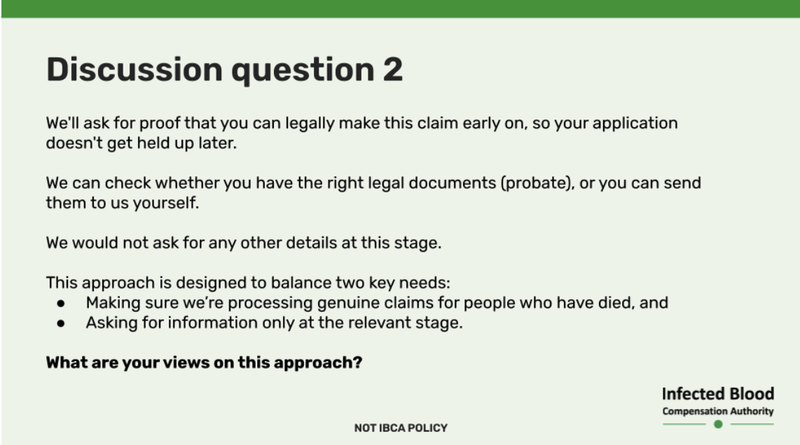
Participants shared that confirming who is legally entitled to make a claim is essential, but the process must be handled with sensitivity and compassion. For many, being asked again to prove their relationship or authority to act feels like reopening wounds that have never fully healed.
A number of parents spoke about how often they have already provided these documents. “If you’ve already had an interim payment, you’ve already sent that in and they’ve used it for the second interim payment. It doesn’t seem right that we need to prove this again,” said one. Another added, “We’ve issued these documents twice. I can’t believe you’d ask for proof of death or probate again. This is what’s killing us. We’re already dealing with losing our children. We just want to let our children rest and for us to go to our resting place with peace of mind.”
Many participants emphasised that requiring documents repeatedly is not only unnecessary but retraumatising. “Unless you’re in our shoes, you don’t understand,” one parent said. “Every day we are living the same pain. This is doubling up on parents’ heartbreak.” Another added, “It’s a waste of your time and resources when they could be used for furthering the claims. It’s double handling everything.”
Several attendees explained that resubmitting legal documents can feel like an accusation or a lack of trust. One said, “It’s like it’s been stretched out deliberately. It’s all very well having these meetings, but don’t ask us to come, re-live the trauma and not actually hear what we’re saying.”
At the same time, participants recognised that confirming legal authority is important for fairness and protection against fraud. One person observed, “When you asked people to register their intent to claim, you could have asked them to upload their probate documents at the same time. Establishing legal entitlement early on is a good way to go about it.” Others noted that this could prevent disputes: “There are going to be instances of people trying to claim when they are not executors of the estate, so it will be important to clarify who is entitled to claim early on.”
Participants described complex family circumstances that could make these requirements harder to navigate. Some said ex partners had received interim payments they felt were not appropriate.“You will have cases where someone who is not an executor of the will tries to make a claim,” one person said. “Families or siblings that are not speaking are all trying to make a claim — how are these to be sorted?”
Across the groups there was consensus that IBCA must give people practical direction early, not wait until a claim is underway. Suggestions included asking for probate documents at the registration stage, providing example templates, and publishing clear links to official sources of help.
Participants also raised the importance of language and emotional awareness in these communications. “We are already dealing with losing our children,” one said. “Every form we fill in, every certificate we have to produce, we are forced to relive their deaths. Please make this easier for us.”
Some people noted that IBCA staff may now be dealing with an older, more vulnerable group of people who require additional care. “With the work done so far, it’s been a different type of person you are working with,” one attendee said. “Now you will be working with older, more vulnerable people. Anything where you can communicate the safeguarding, you will get payback tenfold.”
Participants welcomed the reassurance that IBCA has safeguarding leads and financial advisers in place, but asked that these be visible and easy to reach. “When you are dealing with any problem, you need advice on where to go and what to do,” one said. Some people encouraged IBCA to liaise with the Probate Service to ensure that advice given is consistent, accurate, and trauma informed.
There was also a clear plea for the process to feel human. “You can be the ones that no longer fail us,” one parent said. “It’s time for us to grieve without having to keep reliving this”
Topic 3: Whether to prioritise claims from people who already have the right legal paperwork to represent an estate (probate)
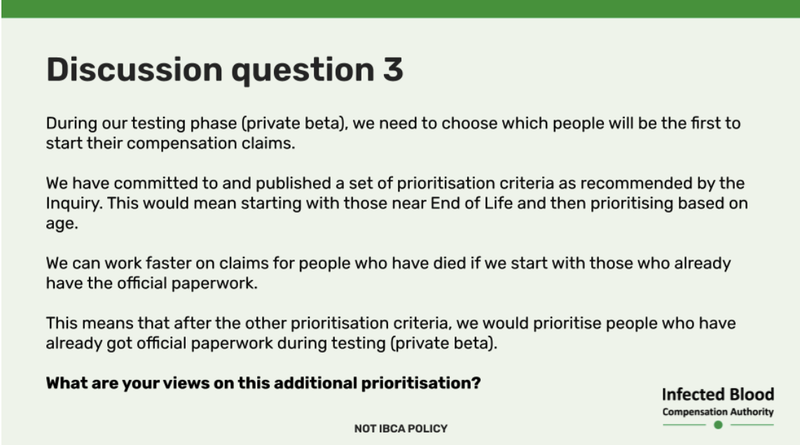
IBCA confirmed that prioritisation would be in line with recommendations from the Infected Blood Inquiry.
There was strong agreement across all five sessions that IBCA should work as efficiently as possible while remaining fair and transparent. Many participants said that if a person already has the necessary legal documents in place, their claim should begin without delay. There was also consensus that those that had lost children should be a priority.
One participant said, “It’s a no brainer. If you have people who have the right documentation, you work with that.” Another added, “We’re ready to go. The efficient way to do things is to pay people who have documentation in line.”
People described long decades of waiting and a wish for closure. “We have been fighting for our children for decades. A lot of parents have died without seeing any justice for their children. It’s time we got some recognition.”
Several participants said it made practical sense to move forward with those “ready to go” while offering support to others still gathering paperwork. “You could split up the claim managers,” one suggested. “Get some to focus on those who are ready to go, then have another group to help those still getting their documents. Don’t just look at one area and concentrate on that — that’s the wrong way to go.”
Others proposed that prioritisation should not be viewed as an unfair advantage but as common sense sequencing. “I don’t think ‘prioritisation’ is the right word,” one participant explained. “You’re just working with the ones that are ready.”
While there was broad agreement that readiness should play a part, participants also cautioned against creating hierarchies that could deepen hurt. “There shouldn’t be any prioritisation,” one said. “There’s only a small group of parents. We’ve all suffered pain.” Another added, “Surely an efficient service is one that has flexibility in it rather than rigid rules that don’t help anyone.”
A group of participants who have never received an interim payment felt they were being overlooked in the prioritisation discussion, acknowledging they "don't want to be prioritised over elderly or end of life but we went through hell with the schemes." They sought clarity on how their long standing trauma and lack of prior compensation would factor into the sequencing, especially since they were excluded from earlier payments due to an administrative cut off date.
Participants repeatedly stressed that claims for deceased infected people should not fall behind living infected claims. Many said they were struggling to accept the idea that families of living infected people might receive compensation first. “If they don’t have probate they shouldn’t be paid,” said one. “It wouldn’t be right to prioritise the unregistered infected above the deceased infected. We already have the proof.”
Others spoke about the emotional impact of feeling pushed further down the queue. “Thirty three years is a long time to wait, and maybe by Christmas someone affected, whose family have already had support payments, will come before us. It doesn’t feel morally right.” Another said, “Being pushed back because they’ve died isn’t fair. You shouldn’t be paying the relatives of someone who is living before recognising the deceased.”
This feeling was particularly strong among those who had lost parents or children decades ago. “Our children paid the ultimate price. They should be a priority.” Another participant reflected, “This is recognition of our dead. These are people, not numbers, not national insurance numbers. We are being penalised for my family dying.”
In later sessions, participants explored the question of whether additional prioritisation could be based on vulnerability, health, or age. Some felt this could help ensure fairness, while others warned that it could become too complex or distressing to evidence. “It’s a very difficult one,” one participant said. “People who have got paperwork should at least start their claims. But how do you quickly and efficiently review someone’s vulnerability?”
Another added, “It should be related to the vulnerability of the beneficiary. That must be prioritised. But it’s almost impossible to establish vulnerability — it could introduce more stress and improbability.”
Participants also raised concerns about transparency and communication. They asked IBCA to make clear how prioritisation decisions are made, and why. “Need to say with clarity what is going to happen, why and when,” one said. “The mystery surrounding the timeline and sequencing needs to be debunked, to make it clear what is happening and why.”
Process suggestions were also raised. Several people said that IBCA could work with community representatives who already have the necessary documents to “lead by example” and help others later.
Participants also discussed fairness between different categories of family members. Some felt that parents who lost children under 18 should be considered first. “Parents who lost their children under 18 should be in the top bracket,” one said. Others raised the need to consider those excluded from estates, such as siblings or long term partners not named in wills. “Some widows are not executors of the will or even included in their husband’s will. How will it be addressed if they don’t have access to probate?”
Despite the diversity of views, participants were united in their hope for closure and compassion. As one said, “Our whole life has been a fight. We want to stop fighting, and that’s down to you.” Another added, “It’s the only way we’re going to get closure.”
Other points
Participants also spoke about wider issues that go beyond the three discussion topics but are vital to how IBCA delivers this work.
Many reflected on the emotional strain of reliving decades of loss and frustration. “The trauma to present the evidence cannot be expressed enough,” one participant said. “Every pause and every step makes it more painful.” Another shared, “We’ve been fighting for our children for decades. I hope we don’t experience any delay. A lot of parents have died without seeing any justice for their children.”
There was a strong call for the process to be trauma informed at every stage. Participants asked IBCA to continue offering safeguarding support, quiet spaces, and access to mental health or bereavement help. Several attendees raised practical barriers that can cause distress for older or unwell family members. They asked IBCA to make sure information is accessible, plain, and not solely online. “A leaflet would be a great idea,” said one. “A lot of people are elderly and won’t have the technical skills.” Others called for clear guidance on inheritance tax, probate fees, and what happens to documents once submitted. “Do we get our copy of probate back?” one participant asked. “We need to know what happens to it.”
Data protection and trust were recurring themes. “We won’t know where information goes after it has been sent in,” one person said. “IBCA needs to be clear on data protection.” Others spoke about the need for transparency to rebuild confidence after years of uncertainty. “The community will view any delays as a tactic,” said one attendee. “Make it clear what’s happening and why.”
Participants also reflected on the importance of compassion and leadership. One participant said: “Our whole life has been a fight. We want to stop fighting — and that’s down to you.”