IBCA session on building a claim service for affected people
Purpose
Between 3 and 6 November 2025, IBCA met with community members to hear their views on how to design a fair, compassionate, and clear compensation service for people making affected claims, in line with the Inquiry recommendations.
Format
Each virtual session lasted around 90 minutes. Each discussion began with an acknowledgement of how distressing the subject can be. Participants were reminded they could take a break or leave at any time.
Notes were shared with all attendees for review and comment before publication. The insights gathered will shape the design of the affected claim journey and how IBCA communicates with this group as claims open.
You can see the slides that were shared in advance of the sessions here.
Topic 1: Our approach to claims while we wait for further documentation
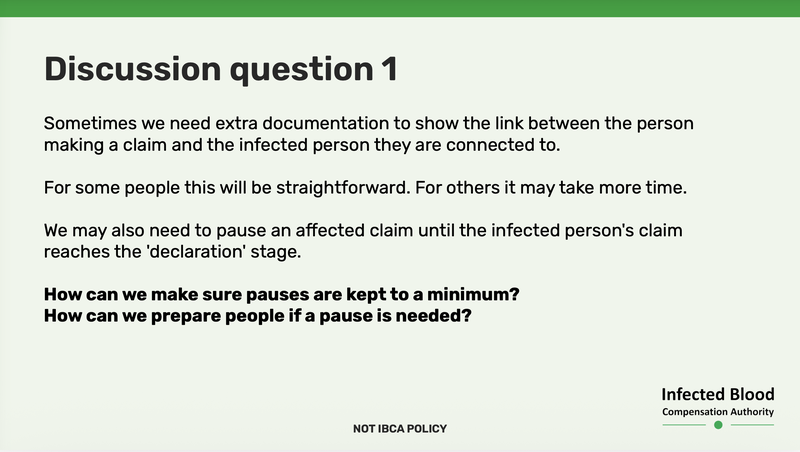
Participants emphasised the critical need for immediate, unambiguous guidance on required documentation for all groups of people who will claim. As one noted, "Organisations are getting the questions now on what it is they will be required to bring to the table."
There is strong demand for a simple, accessible resource — "hot links [links to guidance or where to source documentation] will get people moving on this, stopping any pauses once they start their claim" — that provides a checklist or "a list of the gold standard of evidence" well in advance. Participants were clear that an "unambiguous, clearly available" guide is needed now, outlining "exactly what is needed; no reason why this can't be done now."
Participants repeatedly stressed that clear, early communication is essential and that silence or uncertainty increases anxiety.
Attendees urged IBCA to be realistic about the process and provide reassurance that, as long as everything is explained, the community will understand. Managing "realistic expectation" requires regular updates rather than silence. Ultimately, participants indicated that whilst "people will accept the need for a pause," they want "advance notice" and no surprises about the documentation required.
Attendees acknowledged the complexity of proving complex relationships, particularly with old or inaccurate records, and called for:
- checklist of required documents (gold, silver, bronze tiers)
- early linking of infected and affected claims
- specialist support and a helpline for elderly claimants
- IBCA use of probate records directly
- partnership with community groups
A major concern raised by one group was that "any affected claim is going to have to wait until the infected claim is ready, some of those making previously unregistered claims and estates claims are going to take a long time." To address this, participants urged that links between claims be established "as early as possible, at proof of eligibility" and that the "affected claim needs to be seen in parallel. It needs to be streamlined."
In three sessions, participants highlighted the need for dedicated, specialist support, particularly for the elderly, suggesting signposting them to a helpline and hiring "more specialist people, those that can talk about hep c or hep b or estates claims," mirroring existing charity expertise.
Participants highlighted the severe mental health impact of current documentation requirements, stating: "The stress of the documentation, getting certified copies, have had a terrible impact on the mental health of all involved. People can't keep this up."
An immediate recommendation from the group is for IBCA to utilise public resources independently, as "IBCA can use the probate service in the first instance themselves" rather than placing this burden on claimants.
It was also highlighted that IBCA should work closely with community groups to assist in explaining the claims process and relevant documentation who can help to support the community now.
Attendees emphasised that the process must acknowledge its emotional impact, as it "brings it back to the surface" and "brings up all their trauma." For many claimants, it is fundamentally about "justice and the recognition" rather than solely financial compensation.
Topic 2: Confirming you’re entitled to claim on behalf of someone who has died
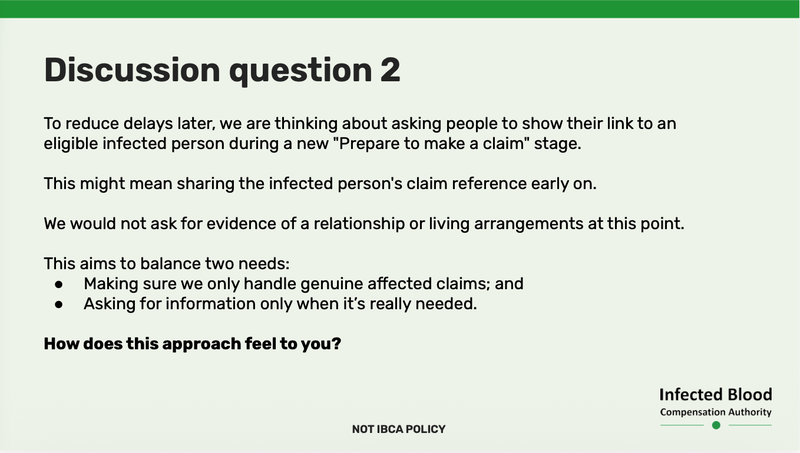
There was strong opposition to rigid reliance on single claim reference numbers as a way of confirming that someone was able make a claim on behalf of someone who had died, described as "verging on the petty."
Attendees reflected that the goal should be to "make it as easy as possible" whilst maintaining security and by using "clear communication and bringing forward documentation from the other schemes" to accelerate the process.
Across all sessions there was a recognition that while straightforward cases could potentially be cleared quickly when information is already held, complex cases require careful management and may be "very long."
There was strong emphasis on prioritising claims efficiently, particularly focusing on "clearing unregistered living infected and estates" first, and expediting claims for the affected of deceased infected to avoid a "massive own goal[that would feel like] a kick in the gut."
Participants stressed the profound psychological impact of uncertainty, with current ambiguity described as "daunting" and something that "anchors their future." Participants said that, particularly for complex cases, IBCA must provide timeframes as soon as possible. The community emphasised the need for transparency through clear communication, including a road map of the claims process, and a template or checklist of documentation in advance so people can "get all their ducks in a row."
Participants want technology that restores a sense of control - such as a secure online portal where they can upload and track their claims. Participants urged IBCA to create "some sort of portal, where they can log on and give as much information as they want," allowing people claiming to "upload as much documentation and evidence as they want to." This ability to be "proactively pushing their own cases forward...will ultimately assist in speedily resolving cases" and is particularly valuable for those "nearing the end of their life."
Key questions focused on the type of proof that would be accepted for difficult relationships, for example a common law partner, with participants asking how this will be proven.
Participants urged IBCA to provide immediate clarity, stating: "We need to know what proof would be accepted, i.e. if you want a birth certificate then we know how to answer and how to respond." They suggested proactively "mapping out the family as soon as possible" and utilising existing databases, such as DWP records to prove carer status, noting that this approach "can assist in dealing with the complex relationships now." Participants highlighted the opportunity to leverage pre-existing links, such as databases of individuals who have received therapy grants or been connected to treatment centres, as a means of identification for a group with potentially greater layers of vulnerability.
Participants emphasised that a number of people have got extremely complicated family problems and urged proactive management of these sensitive situations. To prevent claims going to the "wrong family or wrong group," IBCA must ask for evidence of relationships early, rather than relying solely on claim references which could make people feel excluded.
Topic 3: Whether to prioritise claims from people who already have the right legal paperwork to represent an estate (probate)
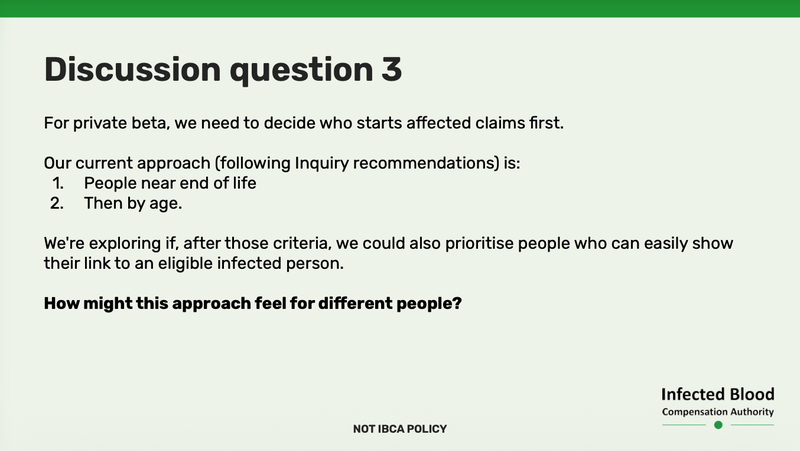
Attendees repeatedly emphasised the critical urgency of the process, particularly for those with limited time, saying: "The clock is ticking for people" and asking "Is there any hope for those nearing the end of life that they will see their claim processed?"
There was strong agreement among participants that:
- end of life cases should be prioritised
- estate claims progressed first
- simple cases cleared quickly
- age/vulnerability considered
One session expressed strong views on who should receive priority in the compensation process. Participants emphasised the need for compassion, particularly for those who have previously received "nothing" and individuals who are nearing end of life. "It is an unfathomable injustice that parents who lost a child have never had a payment." Participants stressed these families should be prioritised, alongside those who "have been waiting 30/40 years for their justice."
The consensus on prioritisation centred on the affected of deceased infected people to avoid what participants warned would be "a massive own goal" and perceived as "a kick in the gut." However, participants acknowledged the complexity: "If an affected claim got called prior to an estate claim, especially a parent or a child, this is going to be difficult to deal with."
Age was also highlighted as an important factor, with participants noting that elderly claimants "should be given the opportunity to enjoy their life."
Participants argued that "simple cases should be prioritised, you can sort out these people very very quickly," particularly for affected claims where "there is less to show, you are only showing your link to that person." They emphasised that once the infected person's eligibility is proven, "there is no reason this should hold up the affected claim."
One practical suggestion was having two teams at IBCA to consider affected and infected to manage the workload.
A participant said : "Can't overstate the value of giving people the ability to get as much documentation and preparation in place for their claim when nearing the end of their life." Additionally, claimants "need to do tax planning, they can't do that without an idea of timings or place in the queue." Ultimately, giving people the ability "to be proactively pushing their own cases forward...will ultimately assist in speedily resolving cases."
Other points
Participants reported daily calls from people at breaking point and warning that "even the strongest of us in the community are nearing their breaking points [for many this is] not a slight delay; it is - will we make it to the end of the process?" One participant described how repeatedly reviewing medical records feels like abuse: "I have lost count how many times I have been through my husband's medical record and trawled through all the hideous stuff that has been done to him. It is abuse." The uncertainty is "really playing with people's heads. You have no idea how much this builds on gaslighting and abuse." A participant said: "Please don't go out there and say (we are) working at pace," and asked for transparency and communication in plain english because the community wants to be told "what is happening, tell us pitfalls, tell us what is going wrong". Others said they were grateful for their participation but urged IBCA to move away from consultation and into delivery.
IBCA confirmed that delivery continues alongside regular community sessions.